"Microsoft Announces Quantum Computing Breakthrough"
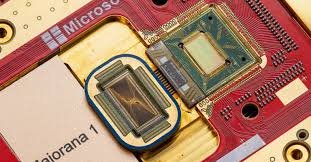
February 2025, Microsoft unveiled its Majorana 1 chip, marking a significant advancement in quantum computing. This chip utilizes a novel architecture known as "topoconductors," which are materials that support topological superconductivity and are theorized to host Majorana zero modes—particles that are their own antiparticles. These topological qubits are anticipated to be more stable and less susceptible to errors compared to traditional qubits, potentially accelerating the development of practical quantum computers.
Developed over nearly two decades of research, Majorana 1 is the first quantum processor produced by Microsoft. It is a hybrid device made from indium arsenide and aluminum, designed to operate at extremely low temperatures (50 mK). While it currently supports eight qubits, the architecture is intended to scale up to one million qubits on a chip measuring just 10 cm by 10 cm. This scalability could enable quantum computers to tackle complex problems in fields such as cryptography, drug discovery, and climate modeling.Microsoft's quantum computing efforts are supported by the U.S. Defense Advanced Research Projects Agency (DARPA) through its Underexplored Systems for Utility-Scale Quantum Computing (US2QC) program. The company plans to integrate Majorana 1 into its Azure Quantum platform, with commercialization efforts aiming for 2030. Despite the promising developments, some skepticism remains within the scientific community regarding the detection and manipulation of Majorana zero modes, as their existence has been a subject of debate.